6/20/2007
Day 8 - We're off to Volcan Tenorio. It's a three hour drive from Nosara to La Carolina, a lodge by a river in La Finca which is Northwest of Bijagua. We arrive after dark to a quaint, candle-lit wooden lodge, whose bedrooms have a window facing the sounds of rapids from a small river downhill. They have a waters-edge wood-fired jacuzzi they fill with river water each day. The sounds of frogs and other night-critters are all around us. Very relaxing...
View Costa Rica June 2007 in a larger map
Day 9 - I love waking up in the thick of these forest voices! Rushing water, light bird songs, frogs, cicadas. At $70/night this place includes three meals a day and two tours during our stay. Today, Spacialle and I took a 2.5 hr hike to Rio Celeste, to the junction between two rivers with very different mineral content. We learned that the mixing of the two rivers creates a beautiful milky light blue water - the result of sulfur and calcium carbonate mixing. The two chemicals produce copper sulfate (CuSO4) which is an irritant at high concentrations but probably not at those found here. However, you don't see fish and aren't supposed to swim beyond the waterfall (possibly due to fast currents).

After lunch we took a horseback tour to explore some of their 175 hectare property. Saw lots of interesting wildlife - the clay-colored robin (national bird), black-cheeked woodpeckers sharing a banana, 3-toed sloth, and a Montezuma Oropendula harem w/ hanging nests. Apparently there can be two males with up to 50 females. Great (or Snowy?) Egret... leaf-cutter ants, and Blue Morpho Butterflies.
Day 10 - Had another fresh and local breakfast (cows milked here, eggs from their chickens, fresh local pineapple juice from nearby farm) with the traditional casado (rice and beans) fresh marmelaide and fruit. And we're off on a 3-hour drive to Santa Elena near Monteverde. Bel Mar is a 4-leaf hotel recommended to us by a friend. I wasn't super impressed, however. Morpho Cafe for dinner was fabulous - sea bass with avacado sauce.
Day 11 - I've decided to head off on my own. There is a biological research station - San Luis Ecolodge and Research Station - 20 minutes away that I had read about and would like to visit. My friends are headed back to Nosara so I decide I'm up for a solo expedition. It feels good to do my own thing for a while.
View Costa Rica June 2007 in a larger map
I'm in a bunkhouse at the station on my own with 4 bunkbeds. $45/night includes meals (with staff, students, scientists, other guests) and all activities - natural history hike, birding hike, night hike, botanical medicine garden tour, cooking workshop, insect workshop, etc. Right when I arrived I ate lunch with a bunch of students and researchers then was told that one of the PhD students had netted an Emerald Toucannette. I took a ride over to watch her tie and glue on a transponder to the bird's tail. Then I joined two of the rookie naturalists (her assistants) to let it go and follow it with an antenna and GPS unit. So exciting!! She was studying the diet of these birds and how it contributed to reforestation efforts.


Back up to the lodge and I asked to join a group of girl scouts as their leader is a well-known educator and naturalist. She knows a lot about rain forest species. The leaf-cutter ants take fragments of many different kinds of leaves so they don't build up too much of one type of toxin on the fungus they're harvesting inside the nest. An example of a mutualistic relationship, the ants pile up the rotting leaf fragments and grow the fungus (always in the Lepiotaceae family) which they harvest and keep free from other pests. They then occasionally harvest this fungus for food. After humans it is thought that they form the most complex and largest animal society's on earth. The next we visited was over 40 feet in diameter but they can be over twice this size with over 8 million ants in the group.
Barbara was an Ecology Professor at Stony Brook University for 25 years teaching everything from to introductory Biology to Plant Ecology and graduate seminars. She served on the OTS board of directors for 15 years and is very well known for being an excellent teacher of teachers in the field of Ecology. Apparently, she was also on the committee over 10 years ago to help create the AP Environmental Science course with the College Board! Barbara talked to me about a 5-week long teacher-training funded by NSF that she's leading at another biological research station called La Selva. Maybe next summer!
Day 12 - Bird hike at 6am with Valerie. I got to see a Steely-vented Hummingbird caught in her net!
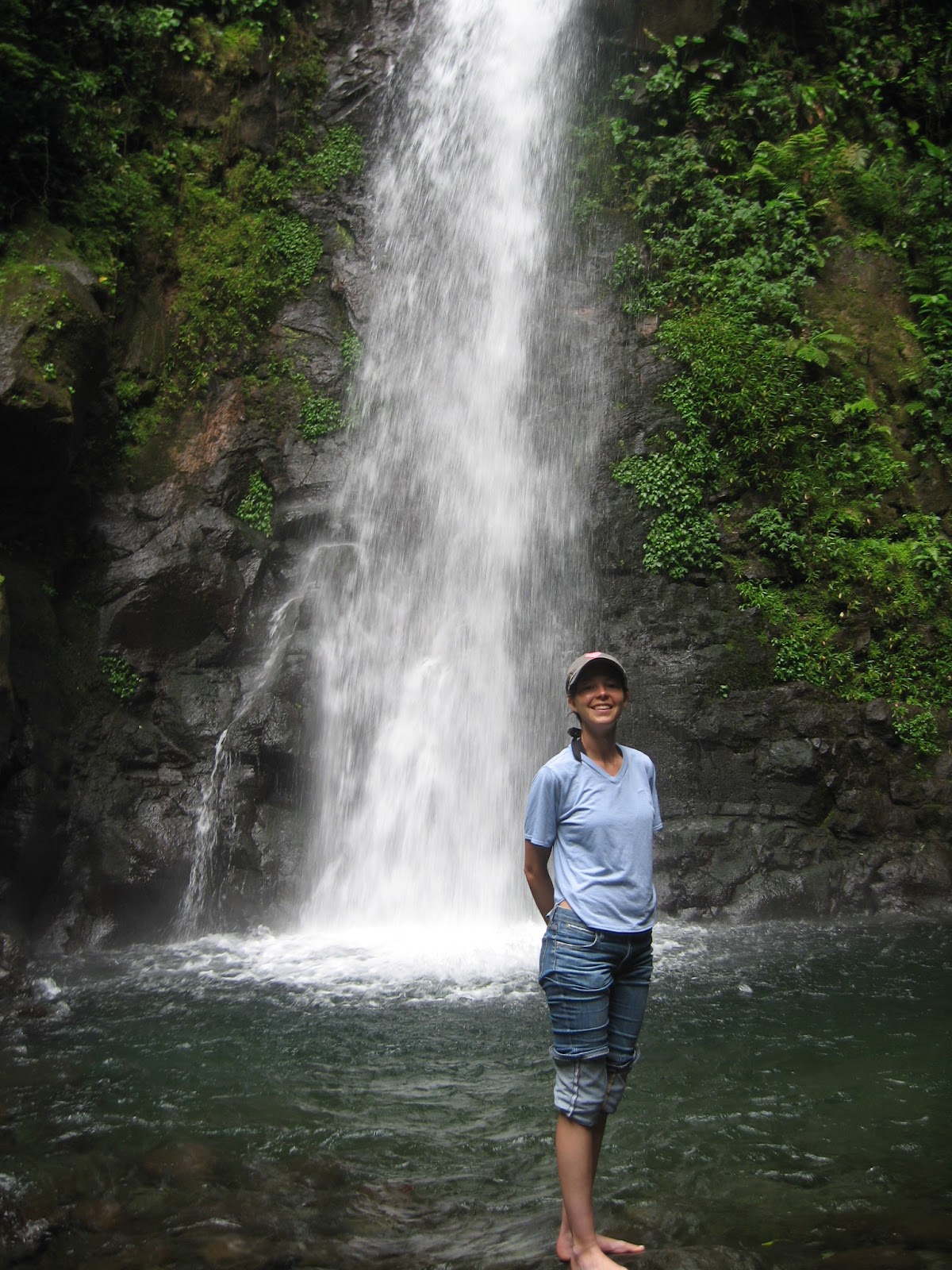
Then up to the 2nd largest waterfall in Costa Rica - the San Luis Waterfall - with Paul, one of the naturalists from England. Beautiful! (you can't see much of it here)
Later, took a tour of the botanic garden on campus. Some researchers (undergrad/grad students, scientists, etc.) study the medicinal and other properties of some of the local flora using this garden. Went on a night hike too... What a different world at night! It was lightly raining with lightning occasionally lighting up the forest. We went to a nearby pond with an orchestra of frogs and toads. Many Cane Toads here! We learn about these in AP Env. Science as being such a horrible invasive species in Australia, but they're native here so kept in check by other species that co-evolved with them. It's so nice to just stand in the light rain at night, turn off flashlights, look, listen and soak it all in.
Back at the bunkhouse, I write in my journal and try to decide where I'm off to next... I've got ten more days.
Day 13 - Got up early and went on the Selvatura Guided Bridge Tour and Zipline. Both for $55! Not bad... It took about 5-6 hours. The bridge tour was a solo tour with Juan Carlos. He knew a LOT and could very easily spot a bird with his telescope. I was VERY lucky to be able to see the endangered 3-Wattled Bellbird! It is a very large bird with long awkward-looking black wattles hanging off of its beak. And its call is so unique. Below is not my video but gives you a close look at it...
During breeding season, the male spends 80-90% of daylight hours high in the canopy on his display perch (known as a "lek") with this loud bonk call to attract the ladies. He then does a special "changing place" display with her where he jumps over her then leans in close and utters more calls in her ear.. Ha! I love him.
We heard a lot from the Gray-breasted Wood Wren (sounds like R2D2). A mated pair calls back and forth to each other as they lose sight of one another while foraging for food. Many wren species have very complex duets. (The Winter Wren up by us is place at the pinnacle of song complexity for birds) We also saw some huge black guans which are a turkey-like bird that is near-threatened here. We watched a yellowish flycatcher beat a moth against a glass window to knock it out before eating it.
Tonight I had dinner with Barbara and some of her chaperones. They wanted to know how I liked traveling alone and she talked more about La Selva, one of the other research stations. She also recommended Rara Avis, an isolated ecolodge near La Selva that one of her former students started. It sounded amazing.
I packed up and took a taxi into Santa Elena to stay at a hostel
called Pension for the next two nights.
Not the best of accommodations – next time, pay another $20 for a place
with a real door and lock. However, nice people there and fast internet! I think I'll head to La Selva then Rara Avis after that...
Day 14 - Caught the 8:30am shuttle to Santa Elena Reserve. Apparently, this is a cloud forest similar to Monteverde but 1/10 the size and 1/10 the number of visitors. My kind of place! At the start of the trails I saw a sweet peccary (relative of a wild pig) just standing by the restrooms. The shuttle driver told us the sad story... he lived in another forest and was abandoned at a young age when his mom died. They relocated him here but he hadn't adjusted well and hadn't joined a new group of peccaries. So, since he'd been slightly habituated to humans, he just hangs out by the bathroom most of the time. Such a sweet face. Wish I could have given him a hug...
I started my hike and met another solo traveler, Sarah, who was about to start her residency as an anesthesiologist. We had a fairly intense 3.5 hour hike along every trail in the reserve. She was very smart and fun to talk to.... We had dinner, shopped around, then went our separate ways.
Day 15 - Off to La Selva! Woke at 5:30 to catch a 6:30 bus to San Jose. Got in at noon then waited until 1:30 at another bus station (Caribe) for a ride to Puerto Viejo Sarapique. I've heard La Selva is one of the places where you'll see the most wildlife in Costa Rica. It's an OTS field station with lots of scientists and students doing research. Again, I'm staying in a room full of bunkbeds all on my own again :). Feels weird but liberating. This place is a bit more expensive. At a tourist rate it's $83/night which includes all meals but only one hike during my stay. The bird hike is $38, night hike $15, etc.
View Costa Rica June 2007 in a larger map
I met a guy named Andon in the computer lab. He is here with REU (Research Experience for Undergraduates?) which is an NSF-funded program. He loves the program and says it's esp. good for underrepresented groups to take advantage of. As undergrads they come over for 10 weeks over the summer and work with a PhD mentor. They choose a research topic and try to get their research published while they're here. Sounds like a tall order! He's studying canopy structure and relating it to the land history in various areas of the park. (secondary vs. old-growth forest) He's using GIS (global information systems) technology to look at aerial views of the canopy in 3D.

I also met Karen at dinner who is studying rodent populations. They mark them by cutting off a tiny toe! Different toes for each rodent. ugh... Another guy is a PhD student analyzing the decline in amphibian populations here. It was previously thought that the chytrid fungus (the potential culprit) which affected amphibians at higher elevations couldn't survive here (Caribbean lowlands) with the higher temperature but they've recently found it here. So they are marking and testing blue jeans frogs and another two species. Here is a frog that we found dead on a hike later on...

Day 16 - I went for a 3-hour hike with one of the naturalists, Kenneth, this morning. He knew so much, it blew my mind. I finally saw the Blue Jeans Frog in the wild!! Apparently it's very abundant and since predators won't go near it, it hunts (ants and other insects) during the day and night (diurnal). It is is very territorial, guarding bromeliad plants that hold pools of water. They lay one egg in each plant they guard until it develops enough to survive on its own. Lots of chirping from these guys. Saw a White-nosed Coati, which is in the raccoon family (Procyonidae) walking along the trail behind us. We had a brief staring contest with him. A pack of 6 or 7 peccaries walked past us seemingly quite acclimated to humans. We also went to one of the swamps to look at frog eggs. So many clumps of them hanging from big leaves, mainly red-eyed tree frog eggs. He tells me it's a real frog party at night since it's been raining and the pond filled back up. Can't wait! I pointed out a snake to Kenneth and he seemed quite shocked that it was the rarely seen but highly venomous Coral Snake.


At lunch I talked to Victor about bringing students here. I know a trip like this would make a big impact on them... would be fun but a lot to coordinate.
After lunch I went with Maria, Andon, and Christina to a less accessible swamp to see if any turtles were in her trap. We had to wear our rain boots, a required item here with the venomous snakes around.... and the mud. Found lots of frogs! When you see them sleeping on a leaf you can pick them up and splash them with water to wake them. You see how the bright colors when they wake and stretch out their bodies to hop away are there to scare off predators.


Finally saw a toucan on my way back! What an awkward animal... After reading the essay about them in Monkeys Are Made of Chocolate last night I have a new appreciation combined with disgust for them. Apparently the large bill evolved for eating or sawing off large fruit but they have been known to eat nestlings and eggs of other birds - this is why flycatchers are often seen dive-bombing them. Also, they were seen by the author dragging a Lineated Woodpecker out of its hole (after she worked a week to create it), beatong it against the tree to kill it, squeezing into the nest, and eating the eggs. Then, after trying out the hole for size, decided it's not big enough. Ah?!
Hot day - cold shower felt good. It's way more muggy and hot here in the Caribbean lowlands than up in the cloud forest or over in the dry forest. Went and listened to a scientist lecture on the effect of phosphorous levels on stream food webs - moderately interesting :)
I learned about so many research projects here today -
1. An undergrad named Matt is looking at seed dispersal differences in primary vs. secondary forests.
2. Danielle is working on her dissertation by studying bat vocalization development.
3. Nick (PhD) tags and tracks antbirds.
4. Cielo is an undergrad who showed me a Green Poison Dart frog she caught and is studying the emergence of the frog in this area as well as medicinal properties of its toxin.
5. Two PhD students are looking for the amphibian declines in this area of 14 different species
6. Sandra is trying to determine the mode of chytrid fungus transmission between frogs and tadpoles.
Nathalie, an undergrad from UC-Berkeley, was doing some interesting work with red-eyed tree frog tadpoles measuring the effects of various pesticides used commonly on pineapple and banana farms in Costa Rica. She took me to her tadpole shed and show me how she is finding the LD-50 (lethal dose of a chemical that kills 50% of a test population) and studies the effects of these chemicals on frog growth and development. Perhaps pesticides and the chytrid fungus are responsible for this massive decline in frog populations?
Many of these people are excited to talk about their work and it's exciting to learn about it. And for some projects I see more of an obvious ecological importance to their work and finding than others. But if someone is studying complex social behavior in ants or birds I also find this fascinating, for a different reason I guess. ...probably an anthropocentric motivation behind it. Anyway, busy day again tomorrow.
Day 17 - The most thrilling and death-defying event of the trip. I went river kayaking for the first time on class 2 and 3 rapids. OMG, I convinced my guide Maurice that I could do the roll (told him I'd been taught to do it in a sea kayak back in 2001 - true). However, when he got me out in the river to prove it he just kept flipping me over while I writhed around frantic and unable to perform! After about half an hour of coaching I got it and we headed off. He told me river levels vary so he would be ahead of me and would shout out orders about the route, what to avoid and where to paddle after a set of rapids. SUPER fun, SUPER scary. At times I was shaking and swearing, but followed that with laughing and cheering myself on. I flipped over once at the end of a set of rapids and as I was trying to do the roll I popped back up to see him close to the end of my boat. He claims I did it on my own.... who knows. We had to get out to avoid two tough sets of Class III rapids. At the end I wanted to hug and high-five everyone I saw but it was just Maurice. He's a trooper for taking out a rookie like me. Def. worth the $50
I made it back in time for a boat tour down another stretch of the Sarapiqui River. Christian was my guide - he'd been out of technical high school for one year and was extremely knowledgeable about birds and other wildlife. He said he wanted to go to UCR for architecture. He talked about problems with the banana and pineapple plantations (too close to river causing erosion, aerial spraying of pesticides causing health problems, blue bags tied around bananas create litter when it floods, etc.)
We saw two river otters swimming which is apparently a rare site. The sunbittern is a very rare and unique-looking bird that we saw - very well camouflaged. It flapped its wings to show the large spots that look like eyes. We also spotted an 11-foot-long crocodile; lots of kingfishers, a spectacled caiman, cormorants, anhinghas (2 similar almost prehistoric birds that don't have the oil glands to repel water), the aggressive Great Kiskadee, a Green Ibis, Green-backed Heron, and a Tiger Heron. Oh, and of course, Howler Monkeys!
When I got back to campus, I went for a solo walk down one of the trails (STR). It's a much different experience being in the forest alone - though you're hardly alone, and very aware of it. I felt more a part of nature and certainly more aware of nature. Can't wait for Rara Avis...
Day 18 - 5:45am bird hike. Finally saw some Green Macaws (only 100 or so left in CR, but apparently this is the spot to see them). My guide, Max, is Costa Rican and interested in conservation ecology. He noticed them by their song as three were flying overhead. Monogamous pairs mate for life and feed their nest-bound young for 3-4 months. There are 90 or so parrot species threatened or endangered worldwide and 2 of the 16 species here are in trouble - the Green and the Scarlet Macaw.
I got to see the oh-so-sweet-looking Gray-necked Woodrail and finally saw a manakin! This was the White-collared Manakin. They are known for their elaborate yet goofy mating displays. Here is a video I found of it...
And then I'm off to
Rara Avis - the most remote eco-lodge in all of Costa Rica, located in 1000 sq. km of contiguous forest shared with Braulio Carillo National Park. I was warned about the 3-hour trek up the mountain to get there. No roads for cars. For much of it you're on a trailor hooked onto a huge tractor. You really have to hold on tight in order to not fall out. In fact, they don't recommend small children or older or disabled visitors for this reason.
We had a 15-minute stop before hiking the last 200 m up. I ran into a guy that helped get this resort off the ground and is THE neotropical bird expert of the world. He wrote the book I had with me on birds of Costa Rica - Gary Stiles. I strong-armed him into taking a picture with me and grilled him about birds he'd seen while there. He was on his way down so we parted ways.
We were at 700 m by the time we got there. It was definitely a bit cooler, more comfortable climate than La Selva. Beautiful place... We had to cross a river that led into a double-waterfall at the end of the journey. A flash-flood had recently destroyed the bridge so I had to cross over holding onto a rope. FELL IN and dunked my camera pretty good, so this is the last picture I took. Luckily all the others were ok.
This place has no electricity - they call it the purest rain forest experience you'll find in CR. Here is a video I found on YT that can show you more....
Day 19 -
Sitting a foot from the edge of what
looks like a 120-foot waterfall watching the water go right over. Looking back at a 70-foot waterfall right
behind me. This place is magical. Saw a Fer-de-lance on the trail today. Thiis species kills more people in CR than
any other. Josh was explaining the
course of action that would be taken if anyone was bitten by one – involved a
helicopter and a very slim chance of survival.
I used another couple’s camera to take a closer photo and upon later
inspection realized how stupid it was to get that close. For some reason I wasn’t as scared as I was
earlier when we spotted the Mussarana on the hike up from Plastico. This one doesn’t often bite humans.
We saw Capuchin Monkeys very close-up
shaking branches at us to try and scare us off.
Miguel, a friendly tapir (rare for a wild tapir) that used to visit the
lodge, died a few days before I arrived.
We smelled him in the forest.
Apparently he was nursed back to health after a vicious jaguar attack
and came around once in a while to say hi.
Would love to see one… Swimming
in the waterfall pool is exciting… and refreshing… and quite a breathtaking sight. Sometimes I just marvel at the idea that I’m
here and wonder how best to enjoy the moment.
Day 20 - Back to San Jose to meet up with my pals... heading home.